Introduction
Mosaic Home Analytics is a software solution designed to assist service providers with analyzing and troubleshooting subscriber home networks. Mosaic Home Analytics has two main uses:
- One-on-one interactions where the Customer Service Representative (CSR) is working with the subscriber, typically over the phone or on-site.
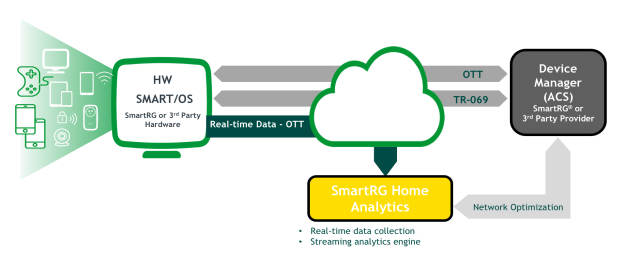
- Service Provider (SP) business analysts and executives who want to aggregate information for their entire population of subscribers. This is made possible by a combination of the Home Analytics Client, which runs on the subscriber home gateway, and the Home Analytics service hosted by ADTRAN, Inc.
Typical use cases for CSRs include visualization and troubleshooting of subscriber home networks. Usually these sessions are precipitated by the subscriber calling the provider to complain about some aspect of their Internet service. In these scenarios, SP staff use the Bandwidth and WiFi pages of the Mosaic Home Analytics user interface to see the connection details of every device in the subscriber's home to better and more quickly understand subscriber complaints. This visibility enables the service provider to deliver higher customer satisfaction.
Without these tools, CSRs would need to ask many questions to build up a picture in their minds before proper resolution steps can be selected and executed. For example, if the subscriber calls complaining that streaming content on their tablet is always low quality and spends a long time buffering, a CSR can instantly see the current and historical WiFi signal strength and compare it to Internet bandwidth consumption for all devices on the subscriber's network. With this information, the CSR can provide immediate and accurate guidance to the subscriber for resolving the issue at hand.
Mosaic Home Analytics helps service providers better understand the status across, and trends within, their subscriber population by analyzing and aggregating individual gateway data. Using various analytical techniques, this aggregate data is displayed as indicators, charts, and maps for easy interpretation. These displays are useful as dashboards to show current high-level status in addition to drilling down into a smaller range of time or area on the map to enable a fast ramp up to understand both a specific problem and its larger context.